USA vs Belgium Stats Breakdown: World Cup Round of 16 Analytics
- Jul 7
- 7 min read
The 2026 FIFA World Cup has already delivered some of the most dramatic storylines in modern soccer history, but few matches carried as much emotional weight and tactical intrigue as the Round of 16 clash between the United States Men’s National Team (USMNT) and Belgium. Played in front of a raucous, sell-out crowd of 66,925 at Seattle Stadium, this high-stakes knockout match ended the co-hosts' dream run with a resounding 4-1 victory for Belgium’s Red Devils.
While the scoreline suggests total dominance, a deeper look into the analytics reveals a complex tactical battle. Under the management of Mauricio Pochettino, the USMNT attempted to rewrite historical precedents but ultimately ran into a clinical, highly disciplined Belgian side coached by Rudi Garcia.
This comprehensive USA vs Belgium stats breakdown dissects the core data points—ranging from possession percentages and passing efficiency to shot locations, expected goals (xG), and decisive defensive errors—to uncover exactly how the match was won and lost on the grandest stage of all.
The Big Picture: Match Overview and Key Context
The USMNT entered the knockout stage with massive momentum. Having finished atop Group D with stellar victories over Paraguay and Australia, followed by a hard-fought Round of 32 win over Bosnia and Herzegovina, the Americans had already scored a program-record 11 goals in a single World Cup tournament. Soccer fever across North America was at an all-time high, and the atmosphere in Seattle promised a true 12th-man advantage.
Pochettino opted for consistency, rolling out an identical starting XI to the one that secured passage through the previous round, featuring a 3-5-2 formation designed to leverage the width of Sergiño Dest and Antonee Robinson while supplying service to Christian Pulisic and Folarin Balogun.
Conversely, Belgium entered the game on an astonishing 17-match unbeaten streak. Rudi Garcia made headlines before kickoff by benching legendary playmaker Kevin De Bruyne—who had started his previous 37 consecutive matches for the national team—opting for a fluid 4-2-3-1 setup anchored by Youri Tielemans and Amadou Onana, with Charles De Ketelaere spearheading the attack.
The tactical gamble paid off immediately. Belgium established control early, suffocating the American midfield and executing their transitional game plan with lethal precision.
Deep Dive: USA vs Belgium Stats Breakdown
To fully understand how the match evolved from a tense 1-1 stalemate in the first half to a 4-1 blowout, we must evaluate the statistical metrics that defined the 90 minutes.
1. Possession and Territorial Dominance
For much of the first half, possession was relatively balanced, but it shifted as the game progressed. The USMNT found themselves chasing the game early after conceding in the 9th minute. Forced to act, the Americans began to dictate the tempo, building sustained sequences in the attacking third.
Metric | United States | Belgium |
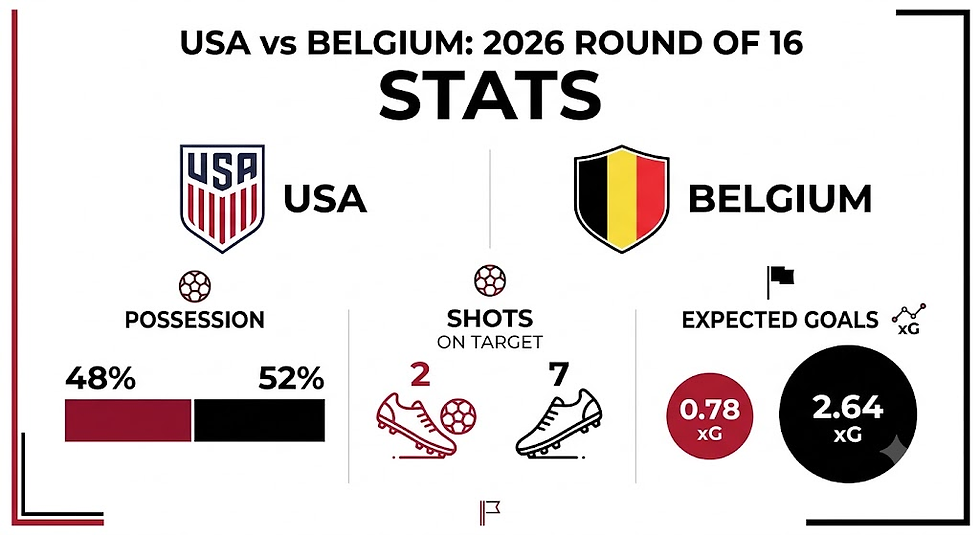
Ball Possession | 48% | 52% |
Pass Completion Rate | 81% | 86% |
Touches in Opposing Box | 14 | 28 |
Corner Kicks | 3 | 5 |
While the USMNT held 48% of the ball, their possession was largely circular and restricted to the middle third or wide channels. Belgium’s defensive block, marshaled by Brandon Mechele and Nathan Ngoy, kept the Americans at arm's length.
Folarin Balogun, who was controversially cleared to play after a U-turn by FIFA reversed his red-card suspension, was completely isolated. The forward registered a mere 10 touches in the entire first half, highlighting the USA's inability to convert possession into dangerous central penetration. Belgium, on the other hand, used their 52% possession efficiently, registering twice as many touches inside the opposing penalty box (28 to 14).
2. Shot Quality and Expected Goals (xG)
The true discrepancy in this match was not how much either team had the ball, but what they did with it. Belgium’s attacking sequences consistently yielded high-probability scoring opportunities, whereas the USMNT struggled to find any clean sights of Thibaut Courtois’ goal.
Total Shots: USA 7 | Belgium 15
Shots on Target: USA 2 | Belgium 7
Saves: USA 3 | Belgium 1
Expected Goals (xG): USA 0.78 | Belgium 2.64
Belgium outshot the United States 15 to 7, but the real narrative lies in the accuracy. Seven of Belgium’s 15 attempts found the target, testing American goalkeeper Matt Freese from the opening minute.
From an Expected Goals (xG) perspective, Belgium accumulated a staggering 2.64 xG. This high number was driven by high-quality opportunities generated inside the six-yard box and clear-cut transitional breakaways. In contrast, the USMNT managed an xG of just 0.78. Take away Malik Tillman’s direct free-kick goal in the 31st minute—which registered a low xG value due to the distance and defensive wall—and the Americans created almost nothing of note from open play.
3. Individual Brilliance: De Ketelaere vs. The USMNT Backline
The undisputed Man of the Match was Charles De Ketelaere. The young Belgian forward put on a masterclass in movement, exploitation of space, and clinical finishing, finishing the night with two goals and an assist.
The Opener (9th Minute): Leandro Trossard switched play beautifully to the left wing. After an initial block by USMNT defender Alex Freeman, Nicolas Raskin collected the loose ball, drove toward the endline, and whipped a low cross into the six-yard box. De Ketelaere timed his run perfectly, beating the sleeping American center-backs to fire home from close range.
The Response and the Brace (33rd Minute): Just two minutes after Malik Tillman brought the USA level with a spectacular direct free kick that deflected off a Belgian defender, Belgium struck back. Leandro Trossard floated a pinpoint left-footed cross into the box. De Ketelaere rose above the veteran American captain Tim Ream, driving a powerful header into the upper right-side netting.
This goal completely deflated the stadium. Coming exactly 61 seconds after the American equalizer, it highlighted a major vulnerability in the USMNT's defensive organization and emotional discipline immediately after scoring.
Tactical Breakdown: How Rudi Garcia Outmaneuvered Pochettino
Mauricio Pochettino’s tactical blueprint relied heavily on his wingbacks, Dest and Robinson, to provide the width necessary to stretch Belgium’s back four. However, Rudi Garcia anticipated this strategy. By deploying Dodi Lukébakio and Leandro Trossard as hard-working wide midfielders who tucked in defensively, Belgium created a numerical overload in the half-spaces.
Furthermore, Leandro Trossard acted as the ultimate creator. Over the course of the tournament, Trossard has been a statistical powerhouse, creating 17 chances and tracking a 2.16 Expected Assists (xA) metric. His ability to isolate Alex Freeman on the flank exposed the lack of international tournament experience in the young American defense.
The Turning Point: Defensive Meltdowns in the Second Half
Pochettino attempted to spark a comeback at halftime by replacing Sergiño Dest with the more attack-minded Giovanni Reyna, shifting to a more aggressive system. However, individual errors quickly doomed the tactical adjustment.
In the 57th minute, a speculative long ball was played behind the USMNT backline. Goalkeeper Matt Freese rushed well out of his penalty area to clear the danger. While he initially controlled the ball, he failed to clear it quickly enough under intense pressing from De Ketelaere. The ball was knocked loose to Hans Vanaken—who had entered the match in the 20th minute for an injured Amadou Onana—and Vanaken calmly lofted a long-range effort into the completely vacant net.
Down 3-1, the USMNT's structure fell apart entirely. Christian Pulisic was forced off later in the half due to an apparent injury, replaced by Sebastian Berhalter. While Berhalter came close with a fierce strike in the 79th minute that flashed just wide, the final blow came in the 93rd minute.
A failed clearance ricocheted off Chris Richards, allowing Maxim De Cuyper to intercept and feed the legendary Romelu Lukaku. Coming off the bench, Lukaku rolled a trademark clinical finish into the bottom corner, setting an elite milestone as the first substitute to score in four different FIFA World Cup matches.
The Historical Implications for U.S. Soccer
Despite the bitter nature of a 4-1 exit on home soil, this tournament marks a pivotal moment for the USMNT. They achieved significant milestones that provide a baseline for the future of soccer in the United States:
They finished atop a highly competitive Group D.
They recorded their first knockout stage victory in 24 years by defeating Bosnia and Herzegovina in the Round of 32.
Mauricio Pochettino walked away with three tournament victories, the most ever for a USMNT manager in a single FIFA World Cup.
However, the stark reality of the USA vs Belgium stats breakdown shows that a massive talent and tactical gap still remains when facing Europe's elite. The Americans have now dropped 11 of their last 12 matches against European opposition in major tournament settings. The heralded "Golden Generation" demonstrated great potential but ultimately lacked the defensive execution required to make the final four.
Frequently Asked Questions (FAQs)
What were the final possession stats for the USA vs Belgium match?
According to the official tournament data, Belgium held 52% of the possession compared to the United States' 48%. However, Belgium was significantly more efficient with their time on the ball, registering 28 touches in the attacking box compared to just 14 for the USMNT.
Who scored the goals in the USA vs Belgium 2026 World Cup match?
For Belgium, Charles De Ketelaere scored a first-half brace (9' and 33'), Hans Vanaken scored in the 57th minute following a defensive error, and Romelu Lukaku sealed the 4-1 victory in stoppage time (90+3'). The lone goal for the United States was scored by Malik Tillman in the 31st minute via a deflected direct free kick.
What does the expected goals (xG) data reveal about this game?
The xG data paints a clear picture of Belgium's attacking dominance. Belgium finished the match with a 2.64 xG, indicating they created multiple high-quality scoring chances. The USMNT finished with a low 0.78 xG, illustrating a major struggle to break down Belgium's defensive block during open play.
Why is a detailed USA vs Belgium stats breakdown important for analyzing the USMNT’s performance?
A detailed USA vs Belgium stats breakdown is essential because it moves past the surface scoreline to expose the core tactical issues. The metrics reveal that despite relatively balanced possession, the USMNT suffered from a severe lack of central attacking penetration (evidenced by Folarin Balogun's 10 first-half touches) and were undone by costly individual defensive lapses.
Conclusion and Next Steps
Belgium's clinical 4-1 triumph earned them a highly anticipated quarterfinal matchup against Spain in Los Angeles. For the United States, the tournament co-hosts leave with their heads held high but with plenty of tactical homework ahead. Pochettino's era has officially begun, and while the foundation is solid, bridging the statistical gap in shot quality and defensive discipline will be the primary objective heading into the next international cycle.
Join the Soccer Analytics Community!
Are you passionate about tactical breakdowns, underlying data metrics, and advanced football metrics? Don't let the conversation stop here!
Analyze More Stats: Check out the official, real-time match data engine directly on the FIFA Official Tournament Hub.
Get More USMNT Updates: Stay completely up to date with roster movements, post-tournament press conferences, and future friendly schedules by visiting the Official US Soccer Federation Website.
Share Your Thoughts: Leave a comment below with your own personal analysis of the game! Do you think Pochettino made the right structural choices, or did Garcia simply outclass him? Let us know!


Comments