West Bengal Election 2026 Predictions: Who Is Leading After Phase 1?
- Apr 24
- 5 min read

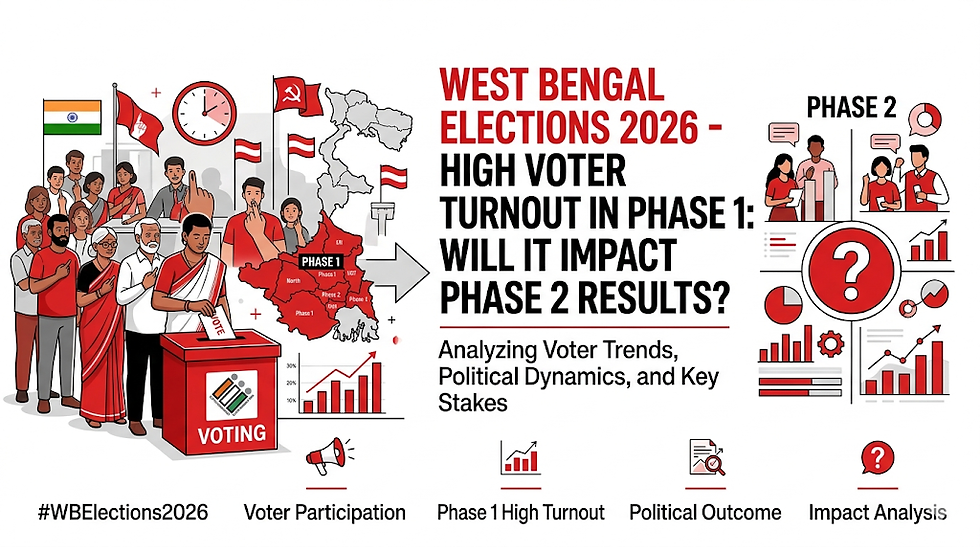
The 2026 West Bengal Legislative Assembly election has entered a crucial stage following the completion of Phase 1 voting on April 23, 2026. With record-breaking voter turnout crossing 90%, political observers, analysts, and voters alike are now asking one key question:
Who is leading after Phase 1?
While official results will only be declared on May 4, early signals based on turnout patterns, ground reports, and political narratives offer important insights into how the contest between the All India Trinamool Congress (TMC) and the Bharatiya Janata Party (BJP) is shaping up.
This blog breaks down the available data, political claims, historical patterns, and expert interpretations to provide a realistic picture of the evolving electoral landscape.
Phase 1 Snapshot: Key Highlights & Early Indicators
Category | Details |
Polling Date | April 23, 2026 |
Seats Covered | 152 constituencies |
Voter Turnout | 91% – 92.8% (approx.) |
Main Contest | TMC vs BJP |
Other Players | Congress, Left Front |
Nature of Seats | Mostly rural & semi-urban |
Reported Incidents | Sporadic clashes, EVM issues |
Overall Mood | Highly competitive |
Phase 1 covered a large number of constituencies, many of which have historically shown strong political engagement and close contests. The unusually
high turnout has added complexity to predictions.
West Bengal Election 2026 Predictions : Can We Predict a Leader After Phase 1?
West Bengal Election 2026 Predictions : It is important to clarify that no official results or exit polls (if restricted) can definitively declare a leader at this stage. However, analysts rely on three major indicators:
Voter Turnout Trends
Ground Reports from Constituencies
Political Narratives and Campaign Strength
Based on these, a tentative trend analysis can be formed—but not a final verdict.
Party-Wise Analysis After Phase 1
1. All India Trinamool Congress (TMC)
The ruling All India Trinamool Congress, led by Mamata Banerjee, remains a dominant force in West Bengal politics.
Strengths after Phase 1:
Strong grassroots network in rural areas
Established governance base
Effective local-level mobilization
What works in their favor:
High turnout in rural belts often benefits entrenched parties
Welfare schemes and local influence
Challenges:
Anti-incumbency sentiment in certain regions
Direct and aggressive challenge from BJP
Assessment:TMC is expected to perform strongly in several rural constituencies covered in Phase 1, but margins could be tighter than in previous elections.
2. Bharatiya Janata Party (BJP)
The main challenger, Bharatiya Janata Party, continues to push for a breakthrough in the state.
Strengths after Phase 1:
Strong central leadership backing
Growing vote share since previous elections
High-energy campaigning
What works in their favor:
High turnout can signal demand for change
Consolidation of opposition votes
Challenges:
Organizational gaps in certain rural areas
Dependence on swing voters
Assessment:BJP is likely to gain in multiple constituencies compared to previous cycles, making the contest closer, but whether it translates into seat wins remains uncertain.
3. Congress–Left Alliance
The combined presence of the Indian National Congress and the Communist Party of India (Marxist) continues, though with limited dominance.
Strengths:
Historical presence in certain constituencies
Alliance vote consolidation
Challenges:
Reduced statewide influence
Bipolar contest between TMC and BJP
Assessment:The alliance may impact results in select seats by splitting votes but is unlikely to emerge as the leading force after Phase 1.
What Does High Voter Turnout Indicate?
The 90%+ turnout in Phase 1 has led to multiple interpretations:
1. Anti-Incumbency Wave?
Some analysts suggest high turnout indicates dissatisfaction with the ruling government, benefiting BJP.
2. Pro-Incumbency Consolidation?
Others argue that TMC supporters turned out in large numbers to defend the government.
3. Increased Political Awareness
A neutral interpretation is that voters are simply more engaged, making outcomes less predictable.
Conclusion:High turnout increases uncertainty rather than clearly favoring one party.
Ground Reports: What Are They Suggesting?
Early field-level inputs from Phase 1 constituencies indicate:
Close contests in a majority of seats
No clear wave in favor of a single party
Localized factors influencing voting patterns
In several constituencies:
TMC retains strongholds
BJP shows visible gains
Margins are expected to shrink
Regional Voting Patterns
Phase 1 included mostly rural and semi-urban constituencies, where:
TMC traditionally performs well
BJP has been expanding its base
Key observations:
Rural turnout remained extremely high
Women voter participation increased
Youth turnout also showed growth
These factors contribute to a highly competitive electoral environment.
Key Variables That Will Decide Leadership
1. Conversion of Votes into Seats
Even small vote swings can lead to large seat changes due to the first-past-the-post system.
2. Swing Constituencies
Close contests in marginal seats will play a decisive role.
3. Opposition Vote Split
Congress–Left alliance performance could influence outcomes in several
constituencies.
4. Momentum for Phase 2
Perceived performance in Phase 1 may impact voter behavior in Phase 2.
So, Who Is Leading After Phase 1?
Based on current indicators:
No clear statewide leader has emerged after Phase 1
TMC appears to retain an edge in its traditional strongholds
BJP is showing competitive gains and narrowing margins
In simple terms:
TMC: Slight advantage in rural areas
BJP: Strong challenger with visible growth
Congress–Left: Limited but influential in select seats
Overall Assessment:The election remains too close to call, with Phase 2 likely to play a decisive role.
What to Watch in Phase 2
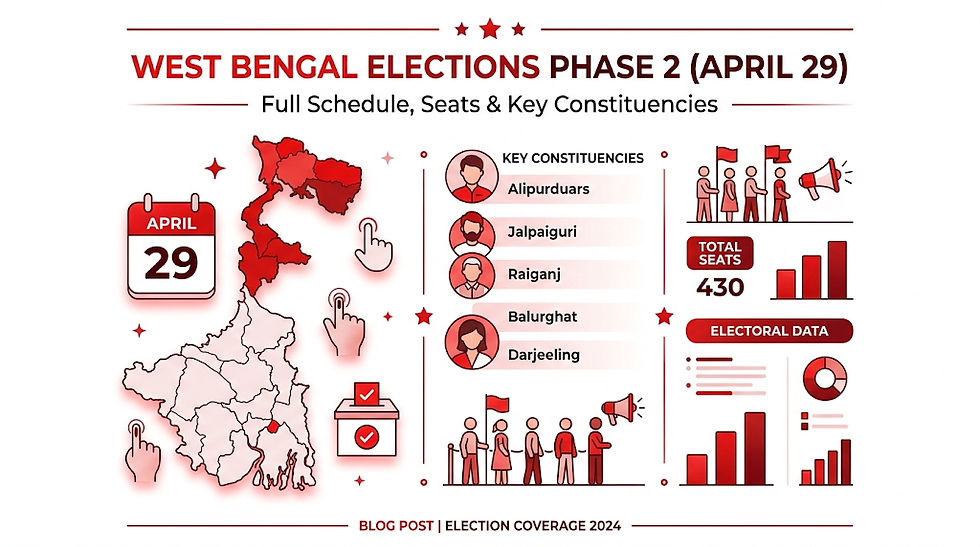
Phase 2 (April 29) will include:
Urban constituencies
Mixed demographic regions
High-profile candidates
Key factors to monitor:
Whether high turnout continues
Urban voter behavior
Campaign strategy shifts
Narrative building by parties
Frequently Asked Questions ( FAQs )
1. Can we declare a winner after Phase 1?
No, results are not declared phase-wise. Final results will be announced on May 4,
2026.
2. Which party is leading after Phase 1?
There is no clear leader, though TMC may have a slight edge in some regions while BJP is gaining ground.
3. Does high turnout favor BJP or TMC?
There is no fixed pattern. Both parties interpret high turnout differently.
4. How reliable are early predictions?
They are based on trends and analysis, not official data, and should be treated cautiously.
5. Will Phase 2 change the outcome?
Yes, Phase 2 is crucial and could significantly alter the final results.
Final Takeaway
After Phase 1 of the 2026 West Bengal Legislative Assembly election, the political landscape remains highly competitive and uncertain.
While the All India Trinamool Congress appears to maintain a slight advantage in its core regions, the Bharatiya Janata Party has emerged as a strong and growing challenger, ensuring that the contest is far from one-sided.
The absence of a clear wave, combined with record voter turnout, suggests that this election could be one of the most closely fought in recent years.
Ultimately, Phase 2 and subsequent phases will determine the final outcome, making it premature to declare any definitive leader at this stage.

Comments