How SpaceX's IPO Created Thousands of New Millionaires Overnight
Introduction: The Day the Space Economy Minted Wealth
For more than two decades, Space Exploration Technologies Corp. operated behind a curtain of private equity, institutional tender offers, and restricted employee stock pools. That all changed on June 12, 2026. When the opening bell rang on the Nasdaq exchange, trading under the ticker symbol SPCX, it didn’t just signal the largest public market debut in corporate history—it fundamentally altered the wealth landscape for thousands of ordinary tech professionals, early engineers, and long-term private backers.
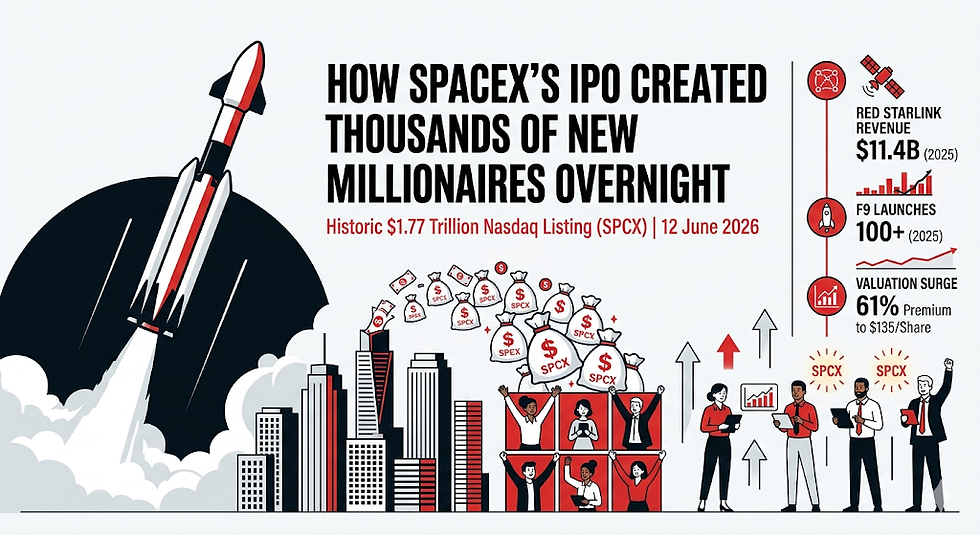
By raising a record-breaking $75 billion by selling 555.6 million shares at a fixed price of $135 each, SpaceX hit the public market with an unprecedented valuation of $1.77 trillion. The market frenzy that followed proved exactly how SpaceX's IPO Created Thousands of New Millionaires Overnight, transforming paper wealth into liquid, life-changing fortunes for its workforce.
While founder and CEO Elon Musk saw his personal net worth surge toward the historic $1 trillion milestone, the real story of this historic listing lies on the ground at Starbase in Boca Chica, Texas, and the engineering bays of Hawthorne, California. Through years of strategic stock-based compensation, internal liquidity programs, and a massive 5-for-1 stock split executed just weeks before the listing, SpaceX built a modern wealth-generation machine.
This deep dive explores the mechanics of this massive liquidity event, the internal structural shifts that catalyzed it, and the data behind the rocket company that turned aerospace workers into a new class of millionaires.
The $1.77 Trillion Math: Breaking Down the Largest IPO in History
To understand the sheer volume of wealth unlocked on listing day, one must examine the staggering financial metrics behind the SpaceX IPO. Breaking the previous world record held by Saudi Aramco's 2019 public listing ($25.6 billion raised), SpaceX’s debut injected a tsunami of capital into the market.
Unlike typical tech listings that rely heavily on venture capital exits, the SpaceX offering was executed purely as a book-built issue of new share creations. This meant that the capital raised went directly toward funding heavy infrastructure projects—namely Starship development, orbital data centers, and massive artificial intelligence arrays—without an Offer For Sale (OFS) component diluting early shareholders.
Metric | Details of the SPCX Listing |
Ticker Symbol | SPCX (Nasdaq) |
IPO Fixed Price | $135 Per Share |
Total Shares Offered | 555.6 Million Shares |
Total Capital Raised | $75 Billion (Can reach $86B via Greenshoe option) |
Implied Market Capitalization | $1.77 Trillion |
Lead Underwriter | Goldman Sachs (with a syndicate of 23 banks) |
Retail Allocation | 25% to 30% of total float |
Trailing 2025 Revenue | $18.7 Billion |
Price-to-Sales (P/S) Multiple | ~94x |
The Valuation Explosion: From Tender Offers to Public Powerhouse
The journey to this multi-trillion-dollar neighborhood was remarkably brief. In December 2025, private secondary market tender offers priced SpaceX shares at roughly $421 on a pre-split basis, tracking an internal valuation of approximately $800 billion.
On May 4, 2026, the company executed a critical 5-for-1 stock split, retroactively adjusting those anchor shares to an equivalent of $84 each. When underwriters locked in the $135 public offering price, it represented an astounding 61% premium over the private valuation from just six months prior. For employees holding blocks of equity accumulated over five, ten, or fifteen years, this mathematical jump was the final catalyst that created generational wealth in a matter of hours.
Employee Equity: How the Hawthorne Workforce Struck Gold
The headline numbers belong to the corporate entity, but the liquid wealth belongs to the staff. Aerospace engineering has historically been a field of solid, upper-middle-class salaries, but SpaceX flipped the script by adopting a Silicon Valley-style compensation model rooted deeply in stock options and Restricted Stock Units (RSUs).
The Anatomy of SpaceX's Wealth Engine
For two decades, working at SpaceX meant sacrificing conventional corporate balance for a shot at history. To attract top-tier talent from legacy defense contractors and elite universities, the company leveraged equity incentives aggressively.
The Early Inception Phase (Pre-2015): Early engineers, machinists, and project managers who joined when the company was fighting to prove the viability of Falcon 9 were granted options at single-digit valuations. Adjusted for multiple stock splits over the years, these early grants were valued at pennies compared to the $135 IPO price.
The Starlink Growth Pivot (2019-2024): As the Starlink satellite constellation began generating consistent global revenue, employee refreshers and performance bonuses were paid out in equity tracking a valuation that grew from $35 billion to over $150 billion.
The Pre-IPO Sprint (2025-2026): Even late-stage hires received RSUs that benefited immensely from the 61% valuation surge between the December 2025 internal tender and the June 2026 public float.
Consider a mid-level systems engineer who accumulated 10,000 post-split shares through merit bonuses, sign-on grants, and internal employee purchase programs over a six-year tenure. At the $135 debut price, that single engineer's equity pool matured into a liquid portfolio worth $1.35 million. Internal estimates suggest that out of SpaceX’s roughly 15,000-strong workforce, up to 25% of full-time staff crossed the million-dollar threshold on paper when the stock officially went live on the Nasdaq exchange.
The Role of Internal Secondary Markets
Unlike employees at most tech startups who must wait helplessly for an IPO to see a single dollar of their equity, SpaceX built an institutional safety valve. Through structured, biannual secondary market tender offers, the company allowed employees to sell limited portions of their vested holdings back to institutional buyers.
This controlled liquidity prevented widespread talent attrition, allowing staff to buy homes and settle debts while keeping the vast majority of their equity locked up for the grand finale: the official 2026 public listing.
The Core Growth Pillars Transforming Paper Wealth into Reality
Skeptics and traditional value investors have openly questioned the company's valuation metrics. At $1.77 trillion, SpaceX trades at an eye-watering 94x trailing price-to-sales multiple. By comparison, high-flying AI chip giant Nvidia trades around 23x, and data-analytics powerhouse Palantir trades near 67x.
So, what exactly are public market investors buying that justifies the wealth of these newly minted millionaires? The answer lies in the company's three distinct, deeply integrated operating pillars revealed in its S-1 prospectus:
1. Starlink: The High-Margin Cash Engine
While launching rockets captures the public's imagination, satellite internet pays the bills. According to the S-1 filing, Starlink generated a staggering $11.4 billion of SpaceX's total $18.7 billion revenue for the full year of 2025. That accounts for more than 61% of total corporate inflows.
Starlink has grown into a financial juggernaut:
Subscriber Scale: Ended 2025 with over 9 million active global subscribers, up from 4.6 million at the end of 2024.
Profitability Profile: Generated over $7 billion in EBITDA for 2025 at an impressive 63% operating margin.
This high-margin, recurring subscription revenue acts as the foundational bedrock for the entire corporation, insulating it from the cyclical nature of traditional aerospace launch contracts.
2. The Launch Division and Starship
The core space infrastructure division brought in $4.1 billion in 2025. SpaceX achieved a historic milestone by executing more launch attempts in 2025 than any sovereign nation on earth. The operational scale of the Falcon 9 and Falcon Heavy platforms remains unchallenged, but the real valuation upside is tied directly to Starship.
As a fully, rapidly reusable heavy-lift transport system, Starship is designed to slash the cost per kilogram to orbit by orders of magnitude. Public markets are pricing in a future where Starship enables point-to-point terrestrial transport, massive orbital asset deployment, and deep-space commercialization contracts with government entities like NASA and the Department of Defense.
3. SpaceXAI: The New Frontier of Silicon and Satellites
The wildcard that truly supercharged the IPO's valuation was the structural integration of xAI. In February 2026, Elon Musk announced an all-stock merger absorbing xAI into SpaceX at a combined transaction valuation of $1.25 trillion, re-branding the unit as SpaceXAI.
This controversial yet highly ambitious move vertically integrated the X social platform, the Grok LLM model, and a massive AI compute footprint directly into the aerospace company. The strategic rationale was made clear during the June 2026 roadshow: SpaceX required cutting-edge artificial intelligence infrastructure to manage autonomous Starlink constellation routing, autonomous Starship piloting systems, and the immense monetization potential of its Colossus 1 data center.
In March 2026, the Colossus 1 facility secured a landmark infrastructure deal with Anthropic worth an incredible $1.25 billion per month running through mid-2029. While this AI expansion caused SpaceX to record a consolidated net loss of $4.94 billion for 2025 due to a $1 billion monthly development burn rate, public investors prioritized the massive infrastructure moat over short-term profitability.
Retail Investors Get a Front-Row Seat
A standard Wall Street public offering typically favors massive institutional asset managers, sovereign wealth funds, and private hedge funds, leaving everyday retail investors to buy residual shares at inflated prices on the open market. However, the SPCX debut broke conventional IPO dynamics.
Elon Musk intentionally placed retail participation at the center of the listing strategy. SpaceX reserved between 20% and 30% of its entire IPO share allocation exclusively for individual retail investors—roughly triple the typical allocation percentage for a major U.S. listing.
Individual orders from retail brokerages exceeded $100 billion during the bookbuilding phase. To accommodate this intense grassroots demand, underwriters systematically scaled back allocations for institutional hedge funds. This structural choice allowed retail backers who had spent years advocating for the space economy to secure equity at the ground-floor $135 price right alongside institutional giants.
Furthermore, because of SpaceX’s monumental market cap, the stock is slated for rapid integration into the S&P 500 and various passive index funds. Consequently, millions of global citizens with standard retirement portfolios, mutual funds, and 401(k) accounts are now directly exposed to the financial trajectory of the commercial space industry.
Looking Ahead: Lockups, Market Dynamics, and Trillionaire Trajectories
While the launch-day pop generated incredible wealth, the real test for SpaceX’s new millionaires lies in the coming months. Under the SEC guidelines established in the S-1 prospectus, insider shares and employee equity pools are subject to a standard rolling lockup expiration period ranging from 90 to 180 days.
This means that while thousands of employees became millionaires on paper on June 12, 2026, their ability to fully liquidate large blocks of stock will open up gradually toward December 2026. Market analysts will be watching closely to see if a wave of employee diversification puts downward pressure on SPCX stock, or if persistent institutional demand absorbs the circulating supply.
Wall Street remains divided on the long-term pricing model. Traditional research firms like Morningstar have issued cautious warnings, pointing out that a fair-value fundamental model based on current risk factors places the intrinsic value closer to $63 per share. They argue that the $135 price relies entirely on a "moonshot scenario" where both rapid Starship reusability and space-based data centers achieve flawless, unhindered commercial deployment by 2028.
Conversely, aggressive tech funds like ARK Invest project that SpaceX is on a clear trajectory to eclipse a $2.5 trillion market cap by 2030, driven by its absolute monopoly over global orbital access and satellite connectivity. Simultaneously, the wealth generated by this offering firmly establishes Elon Musk’s path to becoming the world's very first verified trillionaire, anchoring his industrial empire across automotive tech (Tesla), aerospace infrastructure (SpaceX), and neural interfaces.
Conclusion: The New Dawn of Wealth in Aerospace
The public debut of SPCX marks a watershed moment for the global technology ecosystem. It proved that building heavy hardware, pioneering deep-tech infrastructure, and pursuing seemingly impossible interplanetary ambitions can generate the same type of explosive, democratic wealth creation historically reserved for pure software companies.
The historic Nasdaq listing demonstrated exactly how SpaceX's IPO Created Thousands of New Millionaires Overnight, rewarding the relentless execution of scientists, assembly line workers, software developers, and early believers who chose to build the future of flight. As the capital from this historic listing begins to cycle back into the broader economy, a new generation of venture capital angel investors, deep-tech founders, and space entrepreneurs will emerge from the ranks of SpaceX’s workforce, ensuring that the economic impact of this single listing ripples across the tech world for decades to come.
Frequently Asked Questions (FAQ)
Q: Exactly how SpaceX's IPO Created Thousands of New Millionaires Overnight?
A: The phenomenon of how SpaceX's IPO Created Thousands of New Millionaires Overnight is rooted in the company's long-standing use of equity-based compensation. Over its 24-year history as a private entity, SpaceX consistently compensated its engineers, technicians, and early operational staff with stock options and Restricted Stock Units (RSUs). Following a 5-for-1 stock split in May 2026, the IPO priced shares at a premium of $135 each, valuing the company at $1.77 trillion. This 61% jump over late-2025 private market valuations immediately transformed the accumulated stock portfolios of thousands of long-term employees into liquid fortunes worth over $1 million when trading commenced on the Nasdaq exchange.
Q: What is the official ticker symbol for SpaceX and where is it listed?
A: SpaceX is officially listed on the Nasdaq exchange under the ticker symbol SPCX. The historic initial public offering officially went live for trading on June 12, 2026, following months of intense speculation and the public filing of its S-1 prospectus with the SEC in May.
Q: What percentage of the SpaceX IPO was made available to retail investors?
A: In a significant departure from standard Wall Street conventions, SpaceX allocated between 20% and 30% of its total IPO share pool directly to retail investors. This deliberate structural decision by Elon Musk ensured that individual, everyday backers could access shares at the initial $135 pricing tier, rather than forcing them to buy solely on the open market after institutional bidding.
Q: Is SpaceX currently a profitable company?
A: According to its S-1 prospectus data, SpaceX recorded a consolidated net loss of $4.94 billion for the full year of 2025, despite generating a massive $18.67 billion in revenue. While its Starlink satellite broadband division is highly profitable (throwing off $7 billion in EBITDA at 63% margins), the company's consolidated bottom line is temporarily weighed down by a $1 billion monthly cash burn rate from its newly integrated AI infrastructure division, SpaceXAI (formerly xAI).
Q: How did the xAI merger impact the overall SpaceX valuation?
A: The all-stock merger in February 2026 absorbed xAI into SpaceX at an implied transaction valuation of $80 billion, bringing the combined entity's private valuation to $1.25 trillion. This integration allowed SpaceX to claim direct ownership over the X platform, the Grok AI model, and major physical infrastructure like the Colossus 1 data center. This powerful AI footprint gave public market investors a strong growth narrative, ultimately allowing underwriters to price the public IPO at a record $1.77 trillion.
Stay Connected: Exploring the Commercial Space Frontier
Interested in following the rapid expansion of the global space economy and tracking public market insights? Explore these leading financial and aerospace analysis platforms to stay ahead of the curve:
Track Real-Time Market Data: Follow live trading performance, historical charts, and volume metrics for the historic listing directly on the Nasdaq SPCX Ticker Center.
Deep Dive into SEC Filings: Review the comprehensive financial breakdowns, risk assessments, and revenue streams by reading the official SEC Edgar S-1 Database.
Analyze Space Sector Economics: Stay informed on global satellite deployments, launch manifests, and commercial aerospace valuations at the SpaceNews Business Portal.


Comments