Learn AI or Fall Behind: Breaking Down Jensen Huang’s Urgent Career Advice for 2026
- 2 hours ago
- 8 min read
The corporate landscape of 2026 is governed by a singular, unyielding truth: artificial intelligence is no longer a forward-looking laboratory experiment; it is the core operating engine of global industry. If you are a professional, a programmer, or a student navigating the job market today, you have likely felt the shifting tectonic plates beneath your career path. The anxiety surrounding job security has reached a fever pitch, but perhaps no one has summarized the reality of this transition more bluntly than NVIDIA’s Co-founder and CEO, Jensen Huang.
His foundational doctrine—learn AI or fall behind—has evolved from a prophetic warning into an immediate operational mandate for survival.
During his landmark commencement address to the graduating class of 2026 at Carnegie Mellon University, a global epicenter for robotics and AI development, Huang delivered a reality check that shattered traditional career paradigms. He noted that we have officially entered a "new industrial era," fueled by a staggering $7 trillion global investment infrastructure buildout. From software engineering suites to physical tradecraft, the message from the tech titan is clear: the threat isn't that an abstract AI model will autonomously sit at your desk and steal your job tomorrow. The immediate threat is that a human professional who understands how to leverage AI will displace you.
To navigate this landscape successfully, we must dissect Jensen Huang's career advice, look closely at the macroeconomic data defining 2026, and chart an actionable path forward.
1. The Real Meaning Behind "Learn AI or Fall Behind"
When professionals hear the phrase learn AI or fall behind, many mistakenly assume they need to pause their careers, enroll in an elite university, and acquire a Ph.D. in advanced mathematics or neural network architecture. Jensen Huang’s advice, however, points to a fundamentally different approach. It is not about mastering the complex calculus that operates underneath a model; it is about mastering the practical application of the model itself.
We have entered the era of the democratization of capability. In 2026, natural language has become the ultimate programming language. Because advanced large language models and autonomous agents can interpret human intent with remarkable precision, anyone who can clearly articulate a problem can utilize AI to build a solution.
[Traditional System]
Human Brain ──> Complex Syntax/Code (C++, Python) ──> Machine Execution

[Modern AI Paradigm (2026)]
Human Brain ──> Clear Natural Language (Intent) ──> AI Engine ──> Instant Execution & Scale
Jensen Huang’s career advice centers on this shift. The task of a job (the repetitive writing, the basic data sorting, the syntax debugging) is being heavily automated, but the purpose of a job (problem-solving, strategic architecture, domain expertise) remains intensely human. To learn AI means to bridge the gap between human intent and machine execution. If you are still spending 80% of your workday manually executing repetitive tasks that an automated agent can handle in three seconds, you are actively choosing to fall behind.
2. The Tech Shockwave: Corporate Realities of 2026
To understand why this advice is so urgent, we have to look at the staggering corporate data coming out of the tech sector in 2026. This isn't just theory; it is backed by cold, hard financial mathematics.
NVIDIA’s recent financial results tell the story of an unprecedented industrial transformation. In its Q4 Fiscal 2026 earnings report released in late February, NVIDIA posted a record-shattering quarterly revenue of $68.1 billion—marking an explosive 73% increase year-over-year. Even more telling was their Data Center revenue, which hit $62.3 billion for the quarter, up 75% from the previous year. This momentum skyrocketed even further into Q1 of Fiscal 2027 (reported in May 2026), with revenue jumping an astonishing 85% year-over-year to $81.6 billion, driven by an insatiable global demand for their Blackwell and upcoming Rubin chip architectures.
The Macro View: AI Infrastructure Capital Expenditure (2026)
This isn't a localized trend. The five largest technology hyperscalers globally have committed an aggregate capital expenditure of nearly $660 billion to $690 billion for the year 2026 alone.
Sahi
Tech Corporation | 2026 Planned Capital Expenditure (CapEx) | Core Focus Area |
Amazon | ~$200 Billion | AWS Cloud AI Infrastructure & Agentic Systems |
Alphabet (Google) | $175 - $185 Billion | Gemini Ultra Integration & DeepMind Robotics |
Meta | ~$125 Billion (Up 74% vs 2025) | Llama Open Ecosystem & Physical AI Systems |
Microsoft | $120+ Billion | Azure Copilot Infrastructure & Enterprise Workflows |
This jaw-dropping capital isn't being spent on office buildings or traditional servers; it is being funneled directly into "AI factories"—massive data centers housing hundreds of thousands of interconnected GPUs designed to run reasoning models and autonomous physical agents.
When the gatekeepers of the global economy spend over half a trillion dollars in a single year to rebuild the world’s digital infrastructure, it sends an undeniable message to the workforce. Enterprise AI adoption is accelerating at an unimaginable scale, causing major global tech corporations and consulting firms like TCS, Wipro, and Broadcom to radically alter their hiring frameworks. Job requirements across the board are shifting away from manual execution toward AI-assisted systems integration.
3. The Great Engineering Pivot: From Code to Problem-Solving
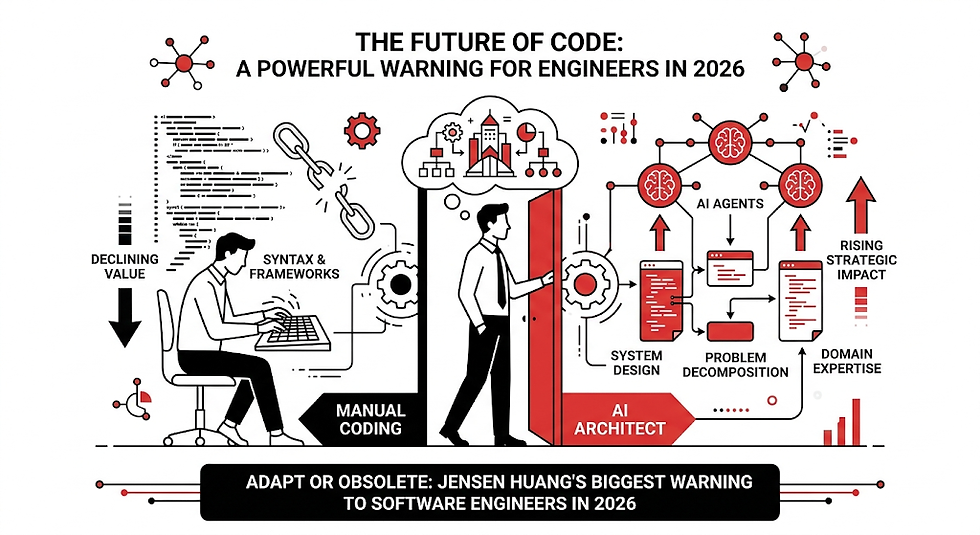
One of the most disruptive aspects of Jensen Huang’s recent commentary is his perspective on the future of software engineering and tech careers. In a statement that sent shockwaves through computer science departments worldwide, Huang remarked:
"Nothing would give me more joy than if none of our engineers were coding at all, and they were just purely solving undiscovered problems."
For decades, learning to code was viewed as the ultimate, bulletproof career move. However, according to data from workforce tracking metrics in mid-2026, approximately 20.4% of corporate tech layoffs this year were explicitly attributed to AI and automation by the companies themselves—a massive spike from less than 8% in 2025.
This statistic shouldn't cause panic, but it must prompt a strategic pivot. AI has changed entry-level hiring equations because it can write functional code, debug scripts, and build databases flawlessly. If your entire professional value proposition is limited to writing boilerplate code or managing basic Content Management System (CMS) databases manually, your role is highly vulnerable.
The engineers, developers, and tech professionals who thrive in 2026 are those who transition into Product Architecture and Physical AI. Instead of spending ten hours writing code, an AI-literate engineer uses a reasoning model to generate the foundation in ten seconds, spending the remaining nine hours and fifty-nine minutes optimizing the system design, ensuring cybersecurity compliance, or integrating the software with physical robotics.
Huang even noted at his CMU address that if he were a 20-year-old student entering the university ecosystem today, he would likely choose the physical sciences over pure software sciences. The true frontier of 2026 is "Physical AI"—the exact inflection point where intelligent software steps out of the screen and begins to interact directly with the real world through advanced semiconductor fabrication, autonomous machinery, and robotics.
4. The Blue-Collar Gold Rush: Physical AI Rebuilds the Real World
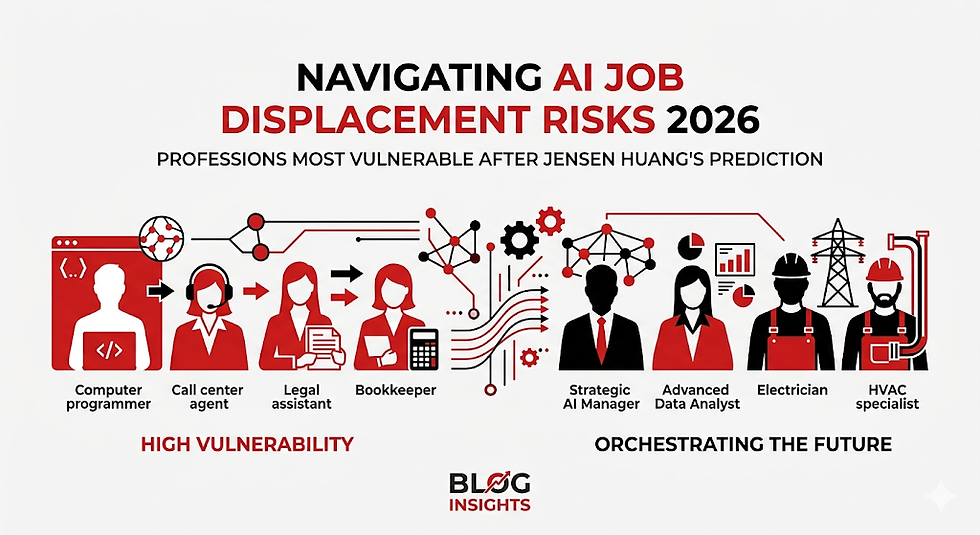
Perhaps the most surprising, contrarian piece of career advice Jensen Huang has offered is his prediction regarding traditional manual trades. While widespread anxiety has focused heavily on white-collar desk jobs, Huang points out that the sheer physical scale of the AI revolution is sparking an unprecedented boom for skilled manual labor.
Building the massive infrastructure required to power the AI era is an intensely physical challenge. It requires an astronomical amount of power, cooling, structural stability, and complex hardware routing.
"AI gives America—and the global economy—the opportunity to build again. Electricians, plumbers, iron workers, technicians, builders—this is your time," Huang declared.
Because the creation of an AI factory requires high-precision physical integration, salaries for specialized tradecraft fields have surged dramatically, often reaching lucrative six-figure marks. A computer model cannot physically wire an advanced liquid-cooled server rack, nor can it lay down the fiber-optic grids or build the cleanrooms required for delicate semiconductor fabrication.
This highlights a vital lesson for career strategy in 2026: true job security lies at the intersection of human dexterity, spatial intelligence, and AI awareness. Whether you are managing an industrial construction site or optimizing a manufacturing workflow, understanding how to coordinate your physical operations alongside AI-driven logistics tracking software is a massive competitive advantage.
5. Blueprint: How to Apply Jensen Huang’s Career Advice
To ensure you stay on the winning side of this technological divide, you must actively build a localized personal strategy. You cannot afford to play passive defense; you have to run directly toward the technology. Here is a clear, tactical process to optimize your daily workflow and upskill your career in accordance with Huang's philosophy.
Develop System-Level AI Literacy:Immediate Phase.
Stop treating AI as a search engine and start treating it as a collaborative team of agents. Learn the mechanics of prompt engineering, model chaining, and context window management. Replace manual research, copywriting, and routine email drafting with highly optimized AI workflows.
Transition from Task Execution to System Architecture:Month 1 - 3.
Identify the most repetitive, time-consuming tasks in your current job or study curriculum. Delegate those entirely to AI tools. Reallocate your freed-up time toward studying system architecture, project management, data security, and end-to-end product design.
Pivot Toward Physical AI and Robotics Integration:Month 3 - 6.
If you are in a technical or engineering field, expand your skill set beyond pure software. Focus on how digital models interact with physical hardware. Study the mechanics of sensor fusion, edge computing, computer vision, and industrial automation frameworks.
Build an AI-Driven Portfolio:Continuous.
Create tangible proof of your capabilities. If you are building platforms, applications, or content databases, document exactly how you used automated agents to scale production, clean data strings, and optimize performance. Show future employers that you are a force multiplier.
6. Frequently Asked Questions (FAQs)
What does Jensen Huang mean by the warning to "learn AI or fall behind"?
When Jensen Huang states that professionals must learn AI or fall behind, he is emphasizing that artificial intelligence has become a foundational tool across every industry. He means that AI will not replace humans directly; instead, professionals who know how to use AI tools effectively will replace those who do not. To stay competitive in the 2026 job market, individuals must learn to automate routine tasks and focus their energy on higher-level problem solving and strategic design.
MEXC Exchange+ 1
Is coding still a viable career option in 2026 according to Jensen Huang?
Yes, coding is still viable, but the nature of coding has changed completely. Jensen Huang points out that because AI can generate functional software syntax instantly, pure "code-writing" is no longer enough to guarantee a premium career. Tech professionals must pivot toward becoming product architects and systems engineers. The value is no longer in knowing where to place a semicolon, but in knowing how to design complex, secure, and highly efficient AI-integrated systems that solve real-world problems.
How is the AI boom affecting traditional non-tech or blue-collar jobs?
According to Huang, the AI revolution is creating an unexpected boom and six-figure salaries for skilled manual trades, including electricians, plumbers, network technicians, and builders. This is driven by the massive, multi-trillion-dollar global infrastructure buildout required to construct chip factories and data centers. Additionally, for non-technical office roles like marketing, law, and administration, basic AI literacy has become a strict requirement to manage automated corporate workflows.
The Economic Times+ 1
What is "Physical AI," and why is it important for future careers?
Physical AI refers to the inflection point where intelligent software models interact with the physical world, such as autonomous vehicles, humanoid robots, smart factories, and semiconductor fabrication systems. Jensen Huang highlights this as the next massive industrial era. For students and professionals, shifting focus toward fields that combine physical sciences with AI—such as artificial intelligence and robotics engineering—provides an incredibly secure and high-impact career trajectory for 2026 and beyond.
Sahi+ 1
Final Thoughts: Run, Don't Walk
The transition into this new industrial era can feel deeply intimidating, but as Huang beautifully reminded the world, every single technological revolution throughout human history has brought a wave of fear alongside its massive ocean of opportunity. When the printing press arrived, when steam power took over, and when the internet first launched, the societies and individuals who retreated lost their ability to shape the future.
The answer to workforce anxiety in 2026 is not to pull back or hope the technology slows down. The answer is to lean in with relentless curiosity, guide the technology responsibly, and use it to amplify your unique human capability. Learn AI or fall behind. The choice is entirely yours. Run, don't walk.
Deepen Your Knowledge & Take Action
Explore the Official NVIDIA Newsroom – Read the full financial breakdowns, Blackwell architecture notes, and corporate data driving the AI industrial revolution.
Watch Jensen Huang's Full CMU Commencement Address – Stream the complete video and view transcription archives from Carnegie Mellon University’s Class of 2026 graduation ceremonies.
Review the Latest AI Industry Career Reports – Dive into real-world statistics, employer surveys, and changing workplace demographics compiled by top global tech publications.

Comments