The Future of Code: Jensen Huang’s Software Engineering Warning in 2026 and How to Survive It
- May 23
- 8 min read
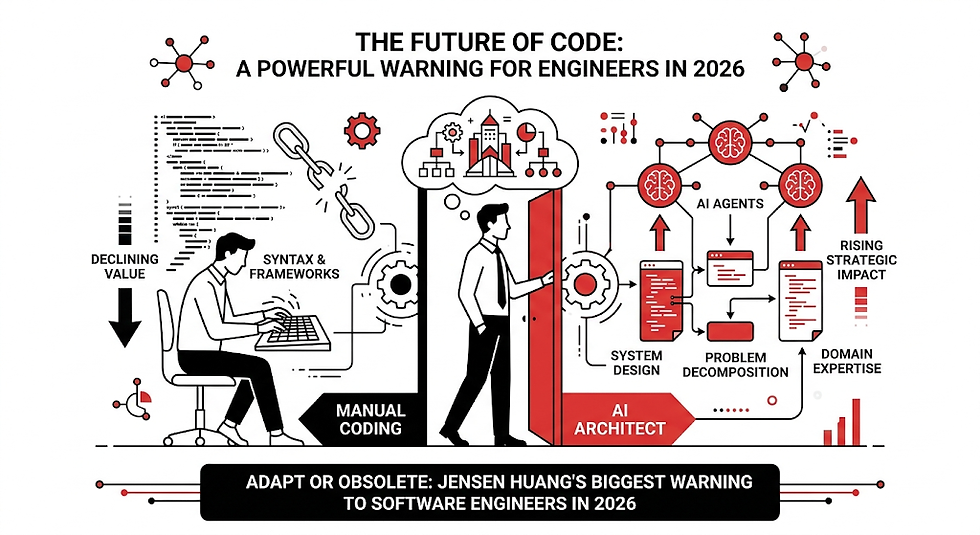
The global technology ecosystem is experiencing a profound paradigm shift. For decades, the advice given to aspiring innovators was uniform, clear, and universally accepted: learn how to code. High schools introduced syntax, universities structured entire departments around compilation mechanics, and coding bootcamps promised a direct line to high-paying engineering roles. However, as we move through 2026, that foundation has fundamentally shifted.
At the latest global technology summits, NVIDIA CEO Jensen Huang delivered his most disruptive message yet. This comprehensive breakdown explores Jensen Huang’s software engineering warning in 2026, analyzing what it means for working developers, how AI coding agents are reshaping enterprise workflows, and the exact steps you must take to remain indispensable in an AI-driven economy.
The Core Blueprint: What is Jensen Huang’s Software Engineering Warning in 2026?
At the heart of Jensen Huang’s software engineering warning in 2026 is a fundamental redefinition of computational literacy. For years, human developers acted as translators, converting human intent into highly specific, syntactically rigid programming languages like C++, Java, or Python.
Huang asserts that this translation layer is rapidly becoming obsolete. In his keynote address, he argued that the traditional concept of "writing code" is no longer the core value driver in software production. Thanks to advances in generative AI, large language models, and hyper-autonomous agents, computing systems can now understand human intent directly.
[Traditional Software Engineering]
Human Intent ──> Manual Translation (Python/Java/C++) ──> Machine Execution

[The 2026 Paradigms Shift]
Human Intent ──> Natural Language / Domain Expertise ──> AI Agents ──> Autonomous Execution
"It is our job to create computing technology such that nobody has to program," Huang noted during a recent industry forum. "And that the programming language is human. Everybody in the world is now a programmer. This is the miracle of artificial intelligence."
This statement is not a declaration that software engineering is dead. Rather, it is a stark warning that the mechanical act of syntax generation—typing lines of code, debugging missing semicolons, and manually structuring boilerplate frameworks—is being fully automated. The real danger lies facing professionals who rely solely on their knowledge of language syntax rather than their ability to design systems, solve complex architecture problems, and understand domain-specific logic.
The Technological Landscape of 2026: Why the Warning Matters Now
To fully comprehend the weight of Huang’s words, we must look at the technological reality of 2026. This warning does not describe a distant, speculative future; it reflects structural changes already embedded within the enterprise landscape.
1. The Rise of Agentic AI Teams
In 2024, AI tools functioned primarily as autocomplete extensions—think early iterations of GitHub Copilot or basic ChatGPT prompt generations. By 2026, these tools have evolved into multi-agent AI networks. Today, enterprise software projects regularly employ networks of specialized AI agents that collaborate autonomously. One agent acts as the product manager, drafting technical specifications; a second agent generates the architecture; a third writes the microservices; and a fourth continuously tests the codebase for vulnerabilities.
2. Massive Productivity Multipliers
Recent empirical data from enterprise DevOps environments reveals staggering metrics:
Code Generation Velocity: Standard microservices that previously required two to three weeks of human development are now scaffolded, validated, and deployed by AI engines in under ten minutes.
Legacy Refactoring: Legacy modernization pipelines (e.g., migrating 30-year-old COBOL or old Java systems into cloud-native architectures) have seen speed increases of over 400%, executed almost entirely by autonomous AI refactoring platforms.
Bug Detection and Remediation: Automated systems now catch up to 85% of runtime vulnerabilities and logical flaws before code ever reaches a staging environment.
For a software engineer whose value proposition is tied to how quickly they can type functional code, these metrics present an existential threat. A single engineer commanding an array of optimized AI agents can now output the equivalent volume of an entire 10-person development team from five years ago.
Deconstructing the Shift: From Syntax Specialists to System Architects
If human language is the new programming language, what happens to the software engineer? The industry is undergoing a massive reclassification of skills. To survive the shift highlighted by Jensen Huang’s software engineering warning in 2026, developers must transition from being syntax specialists to becoming system architects and domain experts.
The Declining Value of Pure Syntax
In the past, memorizing the quirks of memory management in C++ or understanding the intricate threading models of Java made an engineer highly valuable. In 2026, these technical elements are handled efficiently by underlying AI foundational models. When an LLM possesses perfect recall of every API document, framework, and programming language ever created, human memorization of syntax loses its premium value.
The Surging Value of System Design and Prompt Architecture
The premium skill of 2026 is intentional system design. AI agents are exceptionally good at execution, but they require precise, logical, and strategically sound directions. The modern software engineer must act as a conductor, guiding these autonomous systems. This involves:
Decomposing Complex Problems: Breaking down abstract business goals into logical, modular components that AI systems can reliably generate.
Verifying and Auditing Outputs: Inspecting AI-generated code architectures to ensure security compliance, performance optimization, and architectural integrity.
Cross-Domain Synthesis: Integrating software engineering principles with specific industry knowledge, such as biotechnology, quantitative finance, or industrial logistics.
Actionable Blueprints: How Engineers Can Upskill in 2026
The objective of Huang's warning is not to induce panic, but to drive evolution. The demand for software-driven solutions is higher than ever; what has changed is how those solutions are built. Here is a practical blueprint for upskilling and future-proofing your career in this new era.
1. Master AI-Driven Development (AIDD) Frameworks
Do not resist the integration of AI tools; instead, become the most advanced operator of them in your organization. Shift your focus toward learning how to manage multi-agent development frameworks (such as AutoGen, CrewAI, and advanced enterprise coding suites). Learn how to orchestrate setups where multiple AI models interact, review each other's code, and run automated integration tests.
2. Deepen Your System Architecture Foundations
Invest heavily in learning high-level systems design. Understand how large-scale, distributed systems operate, study microservices orchestration, and master cloud-native data patterns. Focus on concepts like data consistency, high availability, fault tolerance, and system latency. These fundamental concepts remain human domains, requiring intuition and strategic balancing acts that AI cannot reliably replicate on its own.
3. Cultivate Deep Domain Expertise
Technology does not exist in a vacuum. The developers who command the
highest premiums in 2026 are those who couple technical systems design with deep domain mastery.
If you work in healthcare, become an expert in medical data compliance, interoperability standards, and bioinformatics.
If you work in finance, master algorithmic risk models, ledger security, and high-frequency data structures.
By anchoring your technical engineering skills to a specific industry, you ensure that your human insight remains essential for guiding the AI agents building the software.
4. Transition into a "Product Engineer"
The barrier between product management and software engineering has largely dissolved. In 2026, successful engineers focus intensely on user experience, business value, and product market fit. Because the cost of generating software has dropped significantly, the competitive advantage shifts to what you build and why you are building it, rather than just how it is coded.
The Corporate Impact: How Engineering Teams Are Restructuring
The implications of Huang’s warning extend far beyond individual career tracks. Enterprises are actively reimagining the topology of engineering departments to match this new reality.
[Traditional Engineering Team Organization]
Engineering Director ──> Engineering Managers ──> Large Squads of Frontend, Backend, & QA Engineers

[The 2026 Optimized Engineering Team Model]
Engineering Director ──> Elite Product Engineers + Orchestrated AI Agent Swarms ──> Autonomous CI/CD Pipelines
The Death of the "Junior Developer" Cold Start
One of the most disruptive systemic shifts in 2026 is the structural restructuring of entry-level engineering roles. Historically, companies hired junior developers to handle simpler tasks like writing boilerplate code, basic unit testing, and minor bug fixing. Because AI agents now perform these foundational tasks instantly and at a fraction of the cost, the traditional entry-level coding position is rapidly disappearing.
Forward-thinking enterprises are replacing these tracks with AI-accelerated apprenticeship programs. In these frameworks, entry-level engineers are immediately trained to operate as junior product managers and system overseers, using AI agents to execute tasks while focusing their learning on system design, logic review, and enterprise security guardrails.
The Rise of the Hyper-Lean Technical Team
In 2026, technology startups and enterprise innovation business units are incredibly lean. It is now common to see highly successful, globally scaled applications built, maintained, and iterated upon by teams of just two or three elite product engineers working alongside sophisticated AI agent swarms. Capital expenditures are shifting away from massive headcounts and redirecting toward computational power, API tokens, and specialized foundational models.
FAQ Section
Q: What exactly is Jensen Huang’s software engineering warning in 2026?
A: Jensen Huang’s software engineering warning in 2026 highlights that traditional programming languages are being replaced by human natural language due to rapid advancements in generative AI. He warns that developers who focus solely on writing manual syntax face displacement, as autonomous AI coding agents can generate, test, and deploy code much faster than humans. To stay relevant, engineers must pivot toward system design, strategic problem-solving, and domain-specific expertise.
Q: Does this mean software engineering is dead as a profession?
A: No, the profession is not dead, but it is undergoing its most radical evolution since the invention of the compiler. The demand for software architecture, digital systems design, and technological problem-solving is at an all-time high. The mechanical execution of writing code is being automated, turning the software engineer into a high-level system conductor, supervisor, and strategist.
Q: Which programming languages should I learn in 2026?
A: While understanding foundational languages like Python, TypeScript, and Go remains useful for system comprehension, your primary focus should be on understanding architectural concepts, APIs, data systems, and human prompt orchestration. The focus has shifted from memorizing code syntax to mastering logical frameworks and system integration.
Q: How can junior software developers break into the industry in 2026?
A: Junior developers must skip the phase of trying to compete with AI on pure coding speed. Instead, focus on learning end-to-end product deployment, system verification, cybersecurity fundamentals, and specialized industry domains. Emphasize your ability to manage AI tools effectively to build complete, functional applications from start to finish.
Q: What industries are most resilient to this AI automation wave?
A: Industries with complex, highly regulated environments and physical real-world integrations are incredibly resilient. Fields like embedded systems for hardware, medical robotics, defense systems, aerospace engineering, and advanced industrial automation require a high level of physical testing, human accountability, and nuanced decision-making that pure software AI agents cannot replicate.
Conclusion: Embracing the Renaissance of Human Creativity
Jensen Huang’s software engineering warning in 2026 should not be viewed as a bleak forecast, but as an invitation to a creative renaissance. By offloading the tedious, mechanical, and repetitive tasks of syntax generation and bug hunting to intelligent systems, engineers are being freed to focus on what truly matters: solving human problems.
The future belongs to the engineers who can look past the code editor, see the broader architectural picture, and use AI to build solutions that were previously impossible due to time or resource constraints. The programming language of the future is human language, and the ultimate tool is human ingenuity.
CTA & Related Resources
Are you ready to adapt your engineering career to the AI era? Check out these vital developer resources, tutorials, and frameworks to stay ahead of the curve:
Orchestrate Multi-Agent Teams: Build, deploy, and manage autonomous AI developer swarms by exploring the open-source CrewAI Framework.
Master Enterprise AI Orchestration: Learn how to build production-ready multi-agent applications using Microsoft's Semantic Kernel GitHub Repository.
Explore Next-Gen Development Environments: Experience a completely AI-native software development workflow by downloading the Cursor Code Editor.
Deepen Your Distributed System Knowledge: Learn the core architectural principles needed to guide AI agents effectively through the ByteByteGo System Design Fundamentals.
Track the Edge of AI Innovation: Keep up with the hardware and software ecosystems accelerating this transition by following the NVIDIA Developer Technical Blog.


Comments