The Professions Most Vulnerable After Jensen Huang’s Latest AI Prediction: Navigating AI Job Displacement Risks 2026
- 2 hours ago
- 7 min read
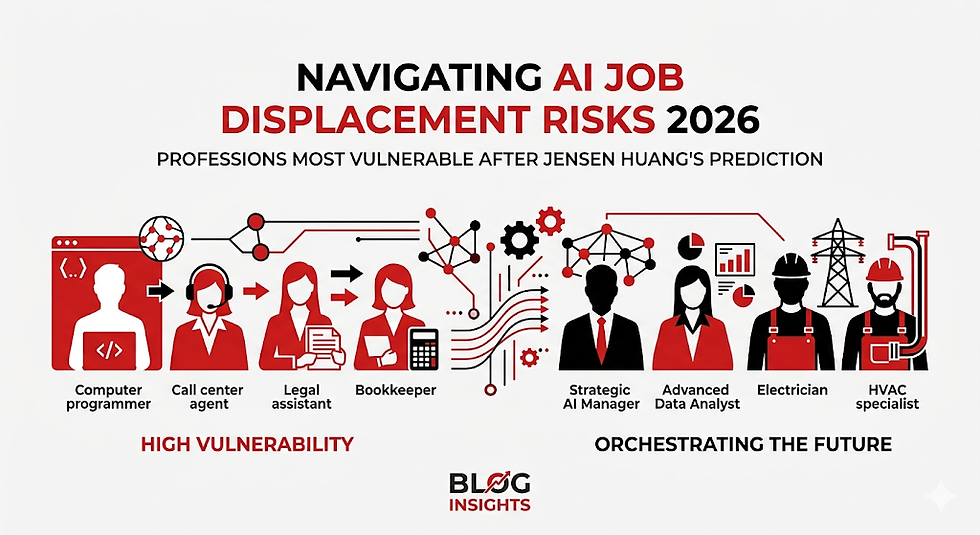
The corporate landscape in 2026 is no longer just talking about artificial intelligence as a future possibility—it is actively managing it as a primary workforce component. If you have been tracking the tech sector closely, you know that Nvidia’s meteoric rise has made its CEO, Jensen Huang, one of the most influential economic voices of our era. When Huang speaks, entire industries recalibrate.
Recently, Huang delivered a series of profound statements regarding the future structure of corporations. His latest core thesis sent shockwaves through the global workforce: he envisions a near-term corporate framework where companies deploy millions of autonomous, agentic AI systems. In fact, Huang noted that Nvidia expects to eventually scale to a ratio where every human employee works alongside roughly 100 AI agents.
While tech optimists point to this as an unprecedented era of human leverage, labor economists are sounding the alarm. The transition to an economy dominated by "digital workers" means certain legacy professions are sitting directly in the impact zone. This extensive analysis breaks down the specific industries facing massive structural shifts, the data backing these changes, and how professionals can mitigate AI job displacement risks 2026 to remain highly valuable assets.
Understanding Jensen Huang’s "100 Agents Per Employee" Paradigm
To comprehend which jobs are most at risk, we must first understand what Huang means by "Agentic AI."
Unlike the early, reactive chatbots of 2023 or 2024 that required continuous prompting for basic text generation, 2026-era agentic AI systems operate with self-directed logic. They can plan multi-step workflows, interact with enterprise databases, cross-reference compliance laws, write their own scripts, and execute transactions without human intervention.
"We expect to have 75,000 employees, the fewest number possible, as large as necessary... working side by side with a staggering 7.5 million AI agents." — Jensen Huang
When one human worker can oversee, manage, and coordinate 100 digital agents running simultaneously, the math becomes stark. Traditional white-collar roles that revolve around manual data aggregation, basic synthesis, mid-tier analytical routines, and template-based execution face immediate downward pressure.
Companies like McKinsey are already operating with over 25,000 active AI agents, and recent enterprise data shows that over 60% of Fortune 500 organizations are actively implementing agentic workflows.
1. Entry-Level Software Engineers and Junior Coders
For decades, learning to code was viewed as an absolute guarantee of career security. However, Huang directly turned this narrative on its head by stating that if he were a student entering university today, he would focus on the physical sciences or biological engineering rather than pure software sciences.
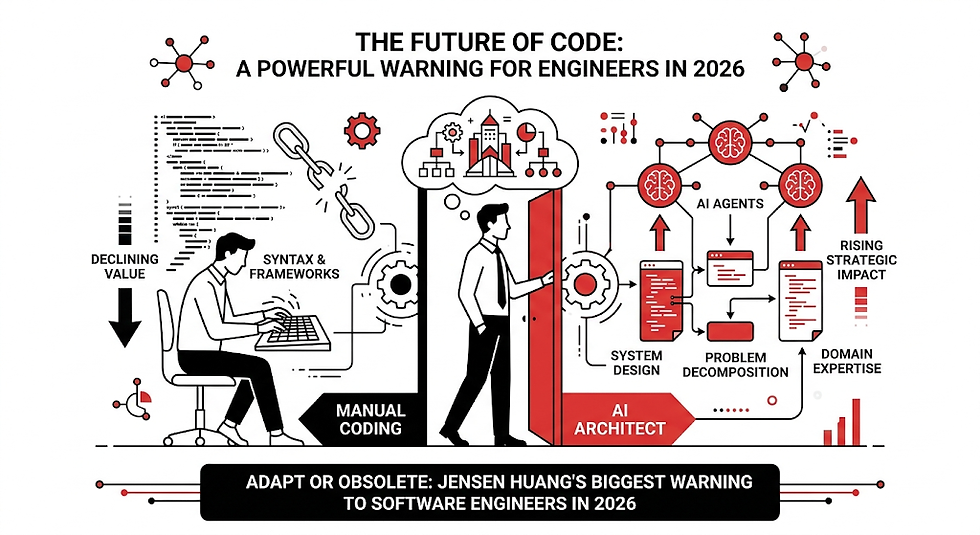
The Shift from Writing Code to Designing Systems
While senior software architects are busier than ever designing massive systems and managing infrastructure, the role of the entry-level syntax coder is rapidly evaporating. 2026 reasoning models can generate clean, optimized, fully documented code across dozens of repositories in seconds.
The Exposure Profile: Junior developers who primarily spend their days writing boilerplate code, fixing minor bugs, or building simple API connections are highly vulnerable.
The Operational Reality: Instead of hiring a team of five junior developers to build a feature, a single product manager using an agentic framework can generate, test, and deploy that feature by lunchtime.
2. Customer Support and Contact Center Specialists
Customer care has long been recognized as a high-exposure area for automation, but the advent of agentic "digital humans" has dramatically accelerated the timeline.
Real-Time Emotional Calibration and Resolution
The days of frustrating, rigid robotic phone trees are gone. Current voice-to-voice models process language with sub-250ms latency, matching human conversational pacing, localized accents, and emotional tone. More importantly, these agents have direct integration with billing systems, inventory logs, and technical databases. They don't just sympathize with a problem—they resolve it end-to-end.
According to 2026 labor data compiled across major automation studies, customer service representatives maintain an exposure score of 9 out of 10. Organizations are rapidly shifting budgets away from massive off-shore call centers and toward centralized, sovereign AI support clouds.
3. Paralegals, Document Reviewers, and Legal Assistants
The legal sector relies heavily on precedent, documentation, and rigorous text-based analysis—characteristics that make it ideal for advanced large language models (LLMs) running agentic loops.
[Contract Ingestion] ➔ [Agent 1: Clause Extraction] ➔ [Agent 2: Compliance Validation] ➔ [Human Lawyer Review]
The End of Manual Document Review
While the lead trial attorney or corporate strategist remains entirely irreplaceable, the support apparatus that enables them is undergoing severe shrinkage. AI agents can scan 10,000 pages of discovery text, extract non-disclosure violations, cross-reference them with regional statutes, and compile a comprehensive brief in under five minutes.
The Data: Research indicates that roles such as paralegals and legal research assistants face some of the highest AI job displacement risks 2026 due to the static, predictable nature of document analysis.
Impact: Law firms are adopting lean billing models. Clients are refusing to pay for hours spent by junior staff on foundational research when an AI model can perform the same action instantly for pennies.
4. Bookkeepers, Junior Accountants, and Financial Analysts
Numbers are the natural native language of artificial intelligence. While strategic financial leadership (CFOs, M&A advisors) requires nuanced human relationship building, the transactional layer of corporate finance is being highly automated.
Financial Job Function | Automation Level (2026) | Primary AI Agent Capability |
Invoice Processing | High (95%) | Automatic extraction, matching, and payment ledgering. |
Tax Compliance Auditing | High (88%) | Continuous cross-referencing of local/federal tax code variations. |
Variance Reporting | Medium-High (82%) | Flagging real-time budgetary anomalies across corporate spend. |
Strategic Capital Allocation | Low (15%) | Broad corporate long-term vision and human macro negotiation. |
As shown above, the technical mechanics of accounting are easily absorbed by automated systems. Junior analysts who spend the majority of their time pulling data into spreadsheets, running basic macro models, and compiling monthly reports are finding their tasks completed faster and with zero human error by internal algorithmic systems.
5. Content Creators, Translators, and Copywriters
The creative and media industries have felt the pressure of generative models for years, but 2026 has brought a shift toward hyper-personalized, programmatic content engines.
Mass Customization Over Mass Production
Localization and multi-lingual marketing no longer require regional agencies. An AI agent can take a singular product brief, generate a localized marketing strategy for 40 different countries, adapt the copy to cultural nuances, and output optimized ad variants seamlessly. This shift has heavily impacted freelance platforms, where basic translation and general copywriting requests have declined significantly.
The Divergent Reality: Where the AI Economy is Creating Jobs
It is critical to note that Jensen Huang’s predictions are not entirely dark. While white-collar sectors face severe compression, he explicitly highlighted a massive, historic labor shortage on the physical side of the technology equation.
The $7 trillion global investment required to build the underlying infrastructure for these millions of AI agents has sparked what Huang terms a "new industrial era." Because AI data centers generate massive amounts of thermal energy, they require extraordinarily complex, high-capacity electrical grids and hyper-advanced liquid cooling systems.
As white-collar workers look to hedge against AI job displacement risks 2026, a surprising trend is emerging: highly skilled manual trades are skyrocketing in value.
Electricians: Needed to wire unprecedented high-voltage industrial server farms.
HVAC and Liquid-Cooling Specialists: Required to design and maintain the complex piping networks that keep dense GPU clusters from overheating.
Network Infrastructure Technicians: Tasked with physically installing, optimizing, and securing the physical fiber arrays that connect massive computing hubs.
Salaries in these specialized trade segments have surged globally, proving that the closer a profession is to the physical constraints of reality, the safer it is from digital automation.
How to Insulate Your Career Against AI Displacement
If your profession falls within the high-exposure white-collar bracket, panic is not a strategy. The professionals who thrive in this agentic era are those who transform themselves into "AI Orchestrators."
If one employee is now expected to manage 100 AI agents, your value no longer lies in doing the work—your value lies in your domain expertise, system design, and prompt architecture.
Develop System Literacy: Learn how to stitch together agentic workflows. Understand how an API connects an AI model to an internal corporate database.
Focus on Deep Domain Context: AI models have broad knowledge, but they lack deep, highly specific organizational context. Become the absolute expert on your company's operational nuances, institutional memory, and strategic client relationships.
Refine Your Judgement Skills: Because AI can produce thousands of lines of code or content instantly, the primary corporate bottleneck is no longer production—it is validation. Cultivate the critical thinking skills required to audit, verify, and approve AI-generated outputs before they go live.
Frequently Asked Questions (FAQs)
What are the main AI job displacement risks 2026 faces according to tech leaders?
The primary AI job displacement risks 2026 centers on the transition from basic task-automation to full agentic autonomy. As tech leaders like Jensen Huang point out, companies are building environments where a single human manager runs up to 100 autonomous digital agents. This heavily reduces the need for middle-tier administrative, analytical, and junior entry-level white-collar workers who traditionally focused on manual data processing, basic software development, and documentation.
Is coding still a viable career path after Jensen Huang's latest comments?
Pure syntax coding—writing basic boilerplate scripts, debugging standard configurations, or building simple templates—is highly exposed to automation. However, software architecture, systems engineering, and managing the physical or systemic deployment of AI engines are seeing massive growth. Aspiring developers must transition from being "code writers" to "system designers."
Which jobs are completely safe from the 2026 AI shift?
No role is completely isolated from technological shifts, but professions requiring intricate physical dexterity, real-time spatial problem solving, and complex manual work are incredibly resilient. Specialized trades like high-voltage electricians, advanced liquid-cooling plumbers, and infrastructural builders are experiencing a historic hiring boom specifically to support the physical data warehouses powering the AI revolution.
Practical Resources and Next Steps
To remain competitive and continually adapt your skillset to the rapidly shifting labor market, explore these strategic career preservation pathways:
Evaluate Your Personal Career Risk: Check exactly where your profession stands by utilizing the task-level automation data from the AI Exposure Index 2026 to analyze cognitive vs. physical vulnerability across hundreds of roles.
Master the Mechanics of AI Agents: Build a foundational understanding of the exact multi-step frameworks Jensen Huang highlighted by taking the comprehensive NVIDIA Agentic AI Explained Course directly from the source.
Learn Advanced Orchestration: Ready to move past the basics? Develop deep, technical workflow skills with the hands-on DeepLearning.AI Agentic AI Curriculum designed to teach professionals how to design, test, and manage multi-agent digital systems.
Build Custom Systems: Learn how to stitch enterprise databases to large language models by studying the official guide on Mastering Agentic Techniques and AI Agent Customization on the NVIDIA Technical Blog.

Comments