SpaceX IPO 2026: How Elon Musk Pulled Off the Largest IPO in History
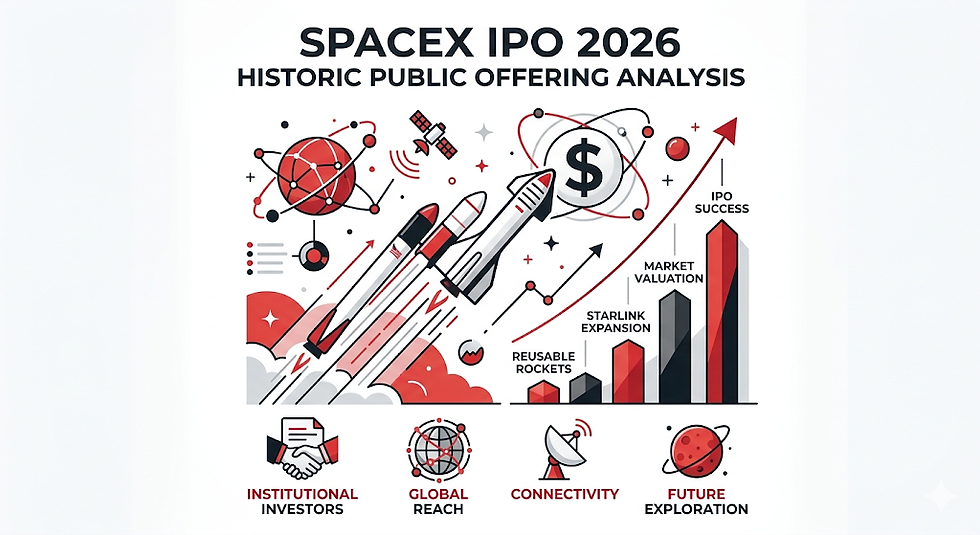
On June 12, 2026, the global financial markets witnessed a tectonic shift. After nearly two and a half decades as a private aerospace titan, Elon Musk’s SpaceX made its long-awaited debut on the Nasdaq exchange, marking the official SpaceX IPO 2026 as the largest and most significant public offering in history. This wasn’t just a listing; it was a watershed moment that reshaped the aerospace industry and redefined what investors expect from a public company.
With a fixed share price of $135 and a record-shattering $75 billion capital raise, SpaceX stepped onto the public stage with a market valuation hovering between $1.77 trillion and $2 trillion. For years, the world watched as SpaceX revolutionized reusable rockets and global satellite broadband via Starlink; today, that innovation is accessible to retail and institutional investors worldwide.
The Strategy Behind the SpaceX IPO 2026
Elon Musk has always defied convention, and the execution of the SpaceX IPO 2026 was no different. Eschewing the traditional "price range" model used by most companies, SpaceX opted for a fixed-price offering of $135 per share. This "take-it-or-leave-it" approach signaled immense confidence, a sentiment validated by an order book that was reportedly three to four times oversubscribed, with institutional heavyweights like BlackRock leading the charge.
Why SpaceX Went Public
While SpaceX has been a prolific private entity, the capital requirements for its ambitious roadmap—spanning the development of the Starship, the expansion of the Starlink network, and the integration of artificial intelligence infrastructure—necessitated a move to the public markets. By going public, Musk aims to secure the massive liquidity required to turn the dream of human colonies on Mars into a concrete reality.
Financial Breakdown: By the Numbers
The sheer scale of this IPO is difficult to comprehend. To understand how SpaceX achieved this, we must look at the financial architecture of the deal.
Metric | Details |
Listing Date | June 12, 2026 |
Exchange | Nasdaq |
Ticker Symbol | SPCX |
Issue Price | $135 (Fixed) |
Capital Raised | ~$75 Billion |
Market Valuation | $1.77 - $2 Trillion |
Primary Underwriter | Goldman Sachs |
This listing makes SpaceX one of the most valuable entities in the world, trailing only a handful of tech giants like Nvidia. The proceeds from this offering are going directly into the company’s growth initiatives, focusing on scaling Starship operations and building out the orbital data center infrastructure that Musk believes will define the next decade of computing.
The "Musk Factor" and Future Growth
The success of the offering is intrinsically linked to the "Elon factor"—the unyielding investor enthusiasm for Musk-led ventures. Following the IPO, Musk’s net worth surged, with many analysts tracking his status as the world’s first trillionaire.
The company’s growth is fueled by three primary pillars:
Starlink Connectivity: Now a profitable powerhouse, Starlink contributes significantly to SpaceX’s revenue, providing high-speed internet globally.
Reusable Launch Services: The Falcon 9 and the revolutionary Starship have drastically lowered the cost per kilogram to orbit, making SpaceX the undisputed leader in space logistics.
AI Integration: Through the acquisition of and partnership with xAI, SpaceX is positioned to be the primary infrastructure provider for space-based AI datacenters.
Market Impact and Regulatory Scrutiny
The SpaceX IPO 2026 has not been without controversy. Because SpaceX shares were distributed into index funds far faster than most companies, some analysts, and even some political figures like Senator Elizabeth Warren, raised concerns regarding financial stability and the lack of traditional profitability metrics. Despite this, the market’s appetite for the stock remained insatiable, with thousands of employees becoming millionaires overnight as a result of their equity stakes.
FAQ: Frequently Asked Questions
What was the impact of the SpaceX IPO 2026 on the stock market?
The SpaceX IPO 2026 served as a major catalyst for the technology sector, testing the limits of passive index tracking and compelling major index providers to reconsider their eligibility criteria for mega-cap companies due to the sheer size of the $1.77 trillion valuation.
Is SpaceX still a profitable company?
Yes, SpaceX reported strong financial health leading up to its IPO, with revenue in the $15–$16 billion range for 2025 and approximately $8 billion in profit, largely driven by the explosive growth of the Starlink satellite network.
How does the ticker symbol SPCX trade?
SPCX trades on the Nasdaq exchange. It debuted with a fixed price of $135 and saw an immediate double-digit percentage increase in its first day of trading, reflecting extreme investor demand.
Who were the lead underwriters for the offering?
Goldman Sachs acted as the lead-left bank for the IPO, with other major institutions including Morgan Stanley, Bank of America, Citigroup, and JPMorgan Chase supporting the deal.
Conclusion
The debut of SpaceX on the public markets marks the end of an era where space exploration was exclusively the domain of private venture capital and government contracts. It is now a transparent, publicly traded engine of innovation. Whether SpaceX can maintain its staggering valuation will depend on its ability to execute on the promises of Starship and its AI infrastructure, but one thing is certain: space travel is officially a public interest .


Comments